Handling The
Challenges of Custom Software Development
Launching a custom software development project can be a key way to give your company a competitive advantage in the marketplace, but is also no small endeavor and requires great planning. Taking your time to identify both your true needs and expectations as well as the right partner who can deliver on them will truly pay off in the end. The most successful projects apply the ethic of “measure twice, cut once” as they go about kicking things off. We’ve outlined the larger concerns below:
ESTABLISHING END GOALS

Getting buy-in from all key decision makers is crucial. In ‘agile’-type environments, continuous close coordination with customers/end-users is necessary to ensure that changing/emerging requirements are understood.
OPEN DIALOG

The enemy of any custom software project is a lack of communication. With so many moving parts, everything must be discussed and evaluated, preferably as you go. Promoting teamwork and cooperation as much as possible is key; use prototypes and/or continuous communication with end-users if possible to clarify expectations.
REALISTIC TIMELINES

This is where the majority of failed custom software projects meet their demise. Excessive optimism and a lack of realism can lead to dashed expectations for both sides. Make generous accommodations for all variables, such as planning, design, testing, bug removals, re-testing, iterations, and step-by-step documentation, in order to set expectations.
PROPER TESTING

With any custom app development, testing throughout is essential for eliminating errors, tweaking functionality and fixing bugs. A variety of testing processes should be applied throughout, such as static code analysis/testing, test-first development, unit testing by developers, built-in testing and even diagnostic capability assessment. By checking at every stage, small problems can be fixed before they become big ones.
MANAGING SCOPE CHANGES

Throughout any custom software design process, changes are often inevitable, and often necessary. But as soon as it becomes apparent they’re needed, it’s important to rope in your partner and assess how this change of scope will affect cost and timeline, if at all. All scheduling changes should be noted and if possible, try to work closely with customers/end-users to manage expectations. Employing “agile” development processes can be highly beneficial in these situations.
PROCESS PRIORITIES What to focus on when
ESTABLISH SIMILAR VISION
It’s absolutely crucial that the project lead and the developer partner share the same vision of what the project needs to accomplish. A partner that can not only build what you want, but help shape your vision, is the one who will best develop your product.
 GET AN ESTIMATE FIRST
We provide a consultation with a software architect that is free of charge. We go over the entire custom software, have internal meetings, and come up with an estimate for free. You want to know what you are getting into.
CREATE SOFTWARE THAT CAN SCALE
This fits into the “easier said than done” category. Many developers will promise this, but not all have the experience and history of success with fully database-driven software with over millions of active users. Vet your partners wisely.
 KEEP AN EYE TOWARDS INTEGRATION
Making different systems and technologies that all play nicely together is a goal that might take more time and energy upfront, but will pay massive dividends down the road. With awareness of change, we plan ahead.
Be On The Lookout For:
- Lack of Proper Expertise Among In-House Developers
- Lack of Proper Testing Procedures
- Short term business objectives. – hey force development to be rushed, patch oriented, and encourage the wrong sacrifices for small gains now rather than bigger gains later.
MANAGING PROJECT COSTS
Costing out any custom software development project requires a thorough inventory of all the goals and variables. But truly collaborative web application developing companies work diligently to outline them all at the project’s onset for maximum transparency. The project’s full costs will include the development of the software and implementing it within your company. Other variables include:

COMPLEXITY
If your desired AWS migration design involves complex functionality and detailed retrofitting to meet your new parameters (such as tight regulations within your industry), extra personnel and development time will be required, but your AWS migration consultant will advise.
PROJECT LENGTH
Every migration project has different scalability requirements that need to be identified and scoped for as you work toward moving to the cloud. For example, with your AWS migration design goals, how many services are you looking to switch over? How much can be handled by your own IT dept?
IMPLEMENTATION
Depending on how many services you’re trying to move over, as well as how complex those are and what regulations you’ll need to adapt to your AWS migration vendor will detail how those will affect budgets and timelines. If one of your goals is to spread workloads across multiple clouds while preserving connections between workloads, this adds complexity as well, but may be well worth the time and costs.
MAINTENANCE
Reaching MVP (minimum viable product) is often just the first phase of any AWS migration project. Updates in business processes, regulations and requests for new features usually require additional coding to make sure your apps stay functional in the cloud.
INFRASTRUCTURE
An expert AWS migration developer will not just execute the migration services you need, but advise on how best to house it in the cloud as well. This goes back to your AWS migration consulting firm recommending only the appropriate and most efficient services in the first place, and making sure you’re not overpaying for ones you don’t need.
The Loft Towers difference
As a premiere AWS migration company, one of our key differentiators is that we never use offshore resources. This allows us to maximize quality control while still offering peerless services at competitive rates. We get the job done right the first time, so costly rewrites don’t come up later. As an agile mid-sized AWS migration firm, we focus on maintaining an efficient team of highly trained and dedicated engineers.
Avoiding project failure
Delivering industry-leading Amazon Web Services (AWS) migration services always involves potential obstacles. But by taking every precaution imaginable, it’s easier to avoid AWS migration delays, cloud computing frustrations, and unnecessary budget overages. Aligning on expectations, timelines, and logistics with your partner is 90% of the battle. To reach your expectations, we work with our clients to make sure they have the right support team to help them on their end to ensure long-term viability. Be aware of the following factors:

UPFRONT PLANNING
Your consulting Amazon Web Services (AWS) migration developer needs to know your goals, related industry regulations, including rights reserved laws, estimated budget, and your approval process up-front to help stay on track and avoid surprises.

DEADLINES
If your AWS consulting migration partner feels the proposed timing is unrealistically tight to provide the best AWS migration services, the best move is to suggest an alternate timeline even before the project kicks off.

ITERATIVE PROCESS
With an AWS consulting migration firm that believes in an iterative development process, you’ll see multiple iterations of the migration progress and cloud services as you go, allowing check-ins throughout. Regular deliverables and demos ensure a healthy awareness of the migration progress’s best practices and a consistent feedback loop, so there are no surprises.

COMMUNICATION
Migrating any type of software involves constant back and forth. With your commitment to eliminating lag-time and providing smooth, efficient, timely feedback throughout, we can complete your project solutions on time and budget.
A smarter collaboration process
After years of successful AWS migration projects, we’ve learned that the best results begin with us all being on the same page at the start. So we go out of our way to get to know your goals, end-users, logistics, variables, and timelines as deeply as possible before we begin. The more we know upfront, the less backtracking later on in the AWS migration and cloud services solutions process. Here’s our 5-step action plan:
1.
DISCOVERY
The first phase is the meeting of the minds. Here’s where our consulting AWS experts get to know your vision, find out how it aligns with our skills and experience, and truly do our homework before beginning our AWS migration services. Our AWS and cloud migration founders oversee every step for quality control.
2.
ESTIMATE
We kick off each project with an upfront agreement on cost and timing. We’ll offer a plan for AWS migration consulting solutions that will be truly worth the investment, providing specific cloud and migration services details about what you can hold us accountable for at each phase.
3.
ARCHITECT
Our principal skill set, as an AWS migration consulting company, resides here. Our team gets to work, using only the help of in-house developers, applying the right tools and strategies to make your AWS migration efforts a success. And our online project management and consulting services portal help to provide transparency throughout the process.
4.
BUILD
Here’s where our AWS migration architects and consulting developers bring your vision to reality. We loop in your team, give them the reigns, get real-time feedback, and adjust, making sure you get the AWS migration solutions services you’re looking for.
5.
LAUNCH
We’ll be right beside you as you bring your AWS solution into the world. This is where you and your customers will truly reap the benefits of working with a top-tier AWS migration consulting developer. And as your company grows, we can help you make solutions services updates to keep things running at peak efficiency.
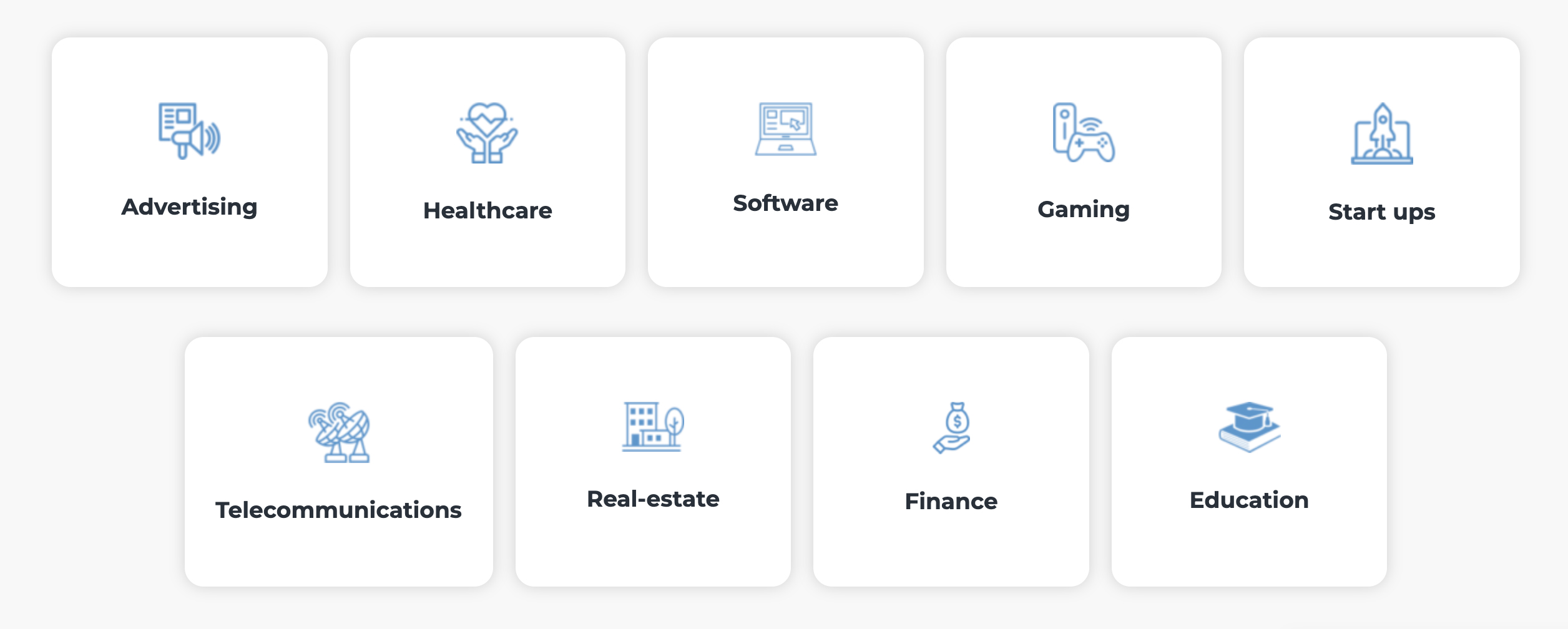
A range of industry experience
We’ve completed AWS migration services for the following industries: